Updated November 2026
Sweepstakes casinos had the most turbulent year in their history and came out of it still growing. Five states passed laws in 2025 explicitly banning sweepstakes platforms that mimic online casinos (American Gaming Association, May 2026), and monthly usage runs twice as high in states without a ban as in states with one (American Gaming Association, Jul 2025).
Every number on this page links to the organization that produced it: state legislatures, gaming regulators, courts, research firms and peer-reviewed journals. No state licenses sweepstakes casinos, so there is no official revenue series for them. Market estimates come from private research and are labeled that way.
Key Takeaways
- 90% of sweepstakes casino users consider the activity to be gambling (American Gaming Association, Jul 2025).
- 68% of sweepstakes players say their main reason for playing is to win real money (American Gaming Association, Jul 2025).
- Half of all online casino ads seen by US consumers in early 2025 came from sweepstakes casinos (American Gaming Association, Jul 2025).
- Sweepstakes demand displaced by state bans is worth at least $1.3B, and California and New York make up 59% of it (Eilers & Krejcik Gaming, Oct 2026).
- Running an online sweepstakes game in California is now a misdemeanor carrying a fine of $1,000 to $25,000 (California Legislature, AB 831, Oct 2025).
- New York fines sweepstakes operators $10,000 to $100,000 per violation (New York State Senate, S5935-A, Dec 2025).
- In Utah, a player who loses money to an illegal gambling device can sue to recover twice the loss (Utah Legislature, Code 76-9-1412, May 2025).
- Legal online casino revenue in the 7 states that allow it grew 27.6% to more than $10B in 2025 (American Gaming Association, May 2026).
- Americans wager $673.6B a year with illegal and unregulated gambling operators (American Gaming Association, Aug 2025).
- Only 24% of online casino players now play exclusively on legal sites, down from 52% in 2022 (American Gaming Association, Aug 2025).
- 26% of social casino gamers who had never gambled online did so within six months (Journal of Gambling Studies, Kim et al., Nov 2014).
- 15% of adults aged 18 to 34 reported concerning gambling behavior, compared with 2% of those 55 and older (National Council on Problem Gambling, Jul 2025).
- Online gambling participation among US adults rose from 15% in 2018 to 22% in 2024 (National Council on Problem Gambling, NGAGE 3.0, Jun 2025).
You can find some of the most prominent takeaways in our video below:
How big is the sweepstakes casino market in 2026?
The bans did not shrink demand for casino-style play. They moved it, and the biggest research firm in the space now tracks where it lands.
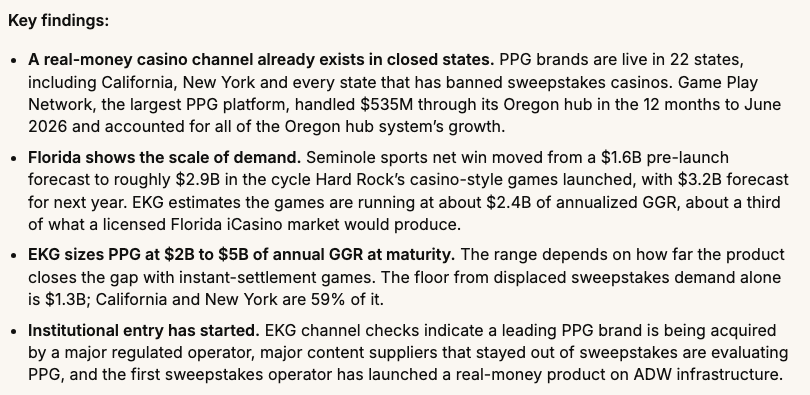
Figure 1: Eilers & Krejcik’s summary of where sweepstakes demand goes after a ban, including the 22-state footprint of pari-mutuel-powered gaming and the $1.3B floor from displaced sweepstakes play. Source: Eilers & Krejcik Gaming, Casino Without iCasino: The Rise of Reveal Gaming, Oct 2026. Screenshot of the source page, captured 28 Oct 2026.
Where does sweepstakes demand go after a state ban?
Mostly into pari-mutuel-powered (PPG) casino-style games that run on horse-racing licenses.
- PPG brands are live in 22 states, including California, New York and every state that has banned sweepstakes casinos (Eilers & Krejcik Gaming, Oct 2026).
- Game Play Network, the largest PPG platform, handled $535M through its Oregon hub in the 12 months to June 2026 (Eilers & Krejcik Gaming, Oct 2026).
- EKG sizes PPG at $2B to $5B of annual gross gaming revenue at maturity (Eilers & Krejcik Gaming, Oct 2026).
Are sweepstakes operators moving into real-money products?
Yes. The first has already launched one.
- The first sweepstakes operator has launched a real-money product on advance-deposit wagering infrastructure (Eilers & Krejcik Gaming, Oct 2026).
- A leading PPG brand is being acquired by a major regulated operator, according to EKG channel checks (Eilers & Krejcik Gaming, Oct 2026).
Do sweepstakes casinos pay state gaming taxes?
No. Regulated gaming tax revenue fell 1.5% to $1.46B in August 2026, and the AGA attributes part of the shortfall to sweepstakes casinos, skill machines and prediction markets, none of which pay state gaming taxes (American Gaming Association, Oct 2026).
Who plays sweepstakes casinos, and how much do they spend?
Players are not confused about what they are doing. Most of the player data below comes from the American Gaming Association, which represents licensed casinos and opposes sweepstakes casinos, so read it as well-sampled but not neutral.
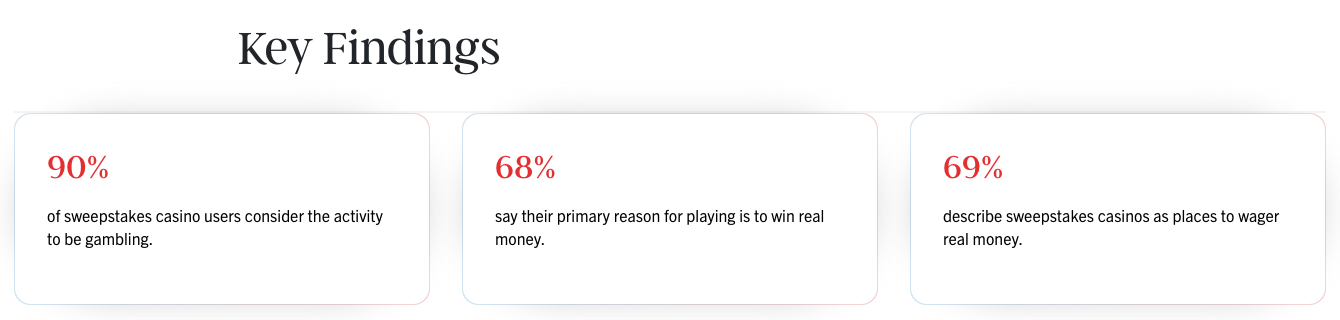
Figure 2: Most sweepstakes players describe what they do as gambling and play to win money, which undercuts the promotional framing the model relies on. Source: American Gaming Association, Sweepstakes Casino Player Profile & Advertising Trends, Jul 2025. Screenshot of the source page, captured 28 Oct 2026.
Do sweepstakes players think they are gambling?
Overwhelmingly, yes.
- 69% describe sweepstakes casinos as places to wager real money (American Gaming Association, Jul 2025).
How often do sweepstakes players spend money?
Most spend every month.
- 80% of sweepstakes casino players spend money monthly (American Gaming Association, Jul 2025).
- Nearly half spend money weekly (American Gaming Association, Jul 2025).
- Sweepstakes casino ads are concentrated in populous states and in states without clear legal guidance or enforcement (American Gaming Association, Jul 2025).
Can free-to-play casino games lead to real-money spending?
The research says purchases are the warning sign.
- The migration study followed 409 social casino gamers who had never gambled online (Journal of Gambling Studies, Kim et al., Nov 2014).
- Only 99 of them completed the six-month follow-up, so the migration rate rests on 26 people (Journal of Gambling Studies, Kim et al., Nov 2014).
- Gamers who made in-game purchases had about eight times the odds of moving to online gambling, the only unique predictor found (Journal of Gambling Studies, Kim et al., Nov 2014).
- In the Big Fish Casino case, virtual chip packs sold for $1.99 to nearly $250 (US Court of Appeals for the Ninth Circuit, Mar 2018).
- The lead plaintiff bought and lost more than $1,000 worth of virtual chips (US Court of Appeals for the Ninth Circuit, Mar 2018).
Where are sweepstakes casinos banned?
In under two years, sweepstakes casinos lost California and New York. If you play, the state you live in now matters more than which site you pick. Check whether sweepstakes casinos are still open in your state.
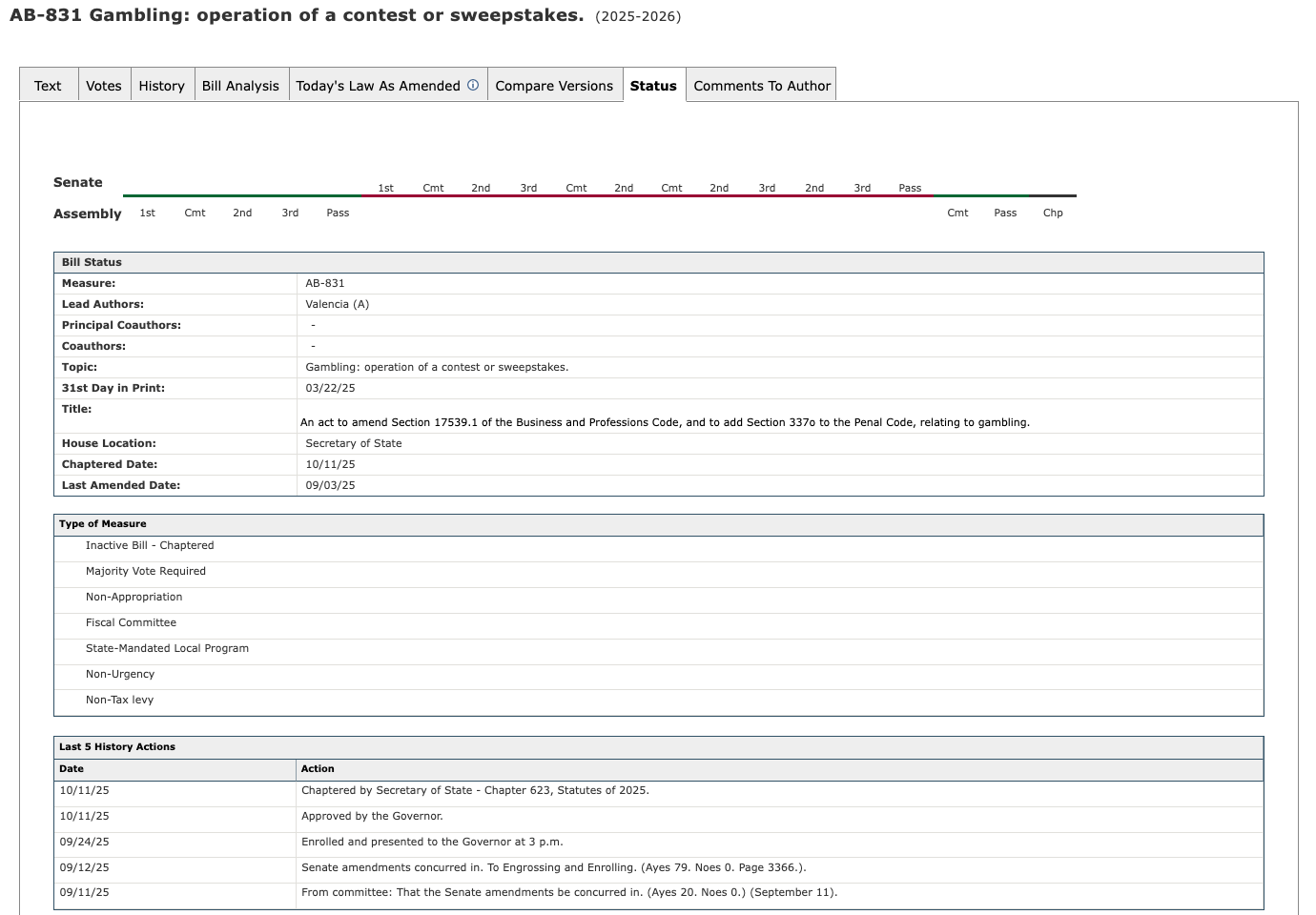
Figure 3: California’s AB 831 cleared the Assembly 79 to 0 and was signed the day it was chaptered. Source: California State Legislature, AB-831 Bill Status, Oct 2025. Screenshot of the source page, captured 28 Oct 2026.
Which states banned sweepstakes casinos in 2025?
California, Connecticut, Montana, New Jersey and New York.
- California’s AB 831 was approved by the Governor on 11 October 2025 as Chapter 623, Statutes of 2025 (California Legislature, AB 831, Oct 2025).
- The Assembly concurred in the final version 79 to 0 (California Legislature, AB 831, Oct 2025).
- California’s ban also reaches payment processors, geolocation providers, content suppliers and media affiliates that knowingly support an online sweepstakes game (California Legislature, AB 831, Oct 2025).
- Games that award no cash prizes or cash equivalents remain lawful in California (California Legislature, AB 831, Oct 2025).
- New York’s S5935-A was signed on 5 December 2025 as Chapter 605 and took effect immediately (New York State Senate, S5935-A, Dec 2025).
- New York’s law bars financial institutions, payment processors, geolocation providers and media affiliates from supporting online sweepstakes games (New York State Senate, S5935-A, Dec 2025).
- Connecticut’s Public Act 25-112 was signed on 24 June 2025 (Connecticut General Assembly, SB 1235, Jun 2025).
- The Connecticut act bars sweepstakes operators from facilitating real or simulated online casino gaming or sports wagering (Connecticut General Assembly, SB 1235, Jun 2025).
Which states followed in 2026?
Maine, Louisiana and Oklahoma are among the states whose bans are confirmed in their legislatures’ records.
- Maine’s LD 2007 was signed on 6 April 2026 and enacted as Public Law Chapter 645 (Maine Legislature, LD 2007, Apr 2026).
- Louisiana’s HB 883 became Act 182 on 15 May 2026, effective 1 August 2026 (Louisiana Legislature, HB 883, May 2026).
- Oklahoma’s SB 1589 passed the Senate 48 to 0 on 2 March 2026 (Oklahoma Legislature, SB 1589, May 2026).
- The Oklahoma House passed it 65 to 21 on 4 May 2026 (Oklahoma Legislature, SB 1589, May 2026).
- Governor Kevin Stitt vetoed the bill on 7 May 2026 (Oklahoma Legislature, SB 1589, May 2026).
- Lawmakers overrode the veto 34 to 10 in the Senate and 68 to 19 in the House (Oklahoma Legislature, SB 1589, May 2026).
What penalties do the bans carry?
Fines, jail time, and loss of licenses.
- A California violation can also bring up to one year in county jail (California Legislature, AB 831, Oct 2025).
- New York violators can lose a gaming license or be barred from getting one (New York State Senate, S5935-A, Dec 2025).
- Connecticut made professional gambling a class D felony (Connecticut General Assembly, SB 1235, Jun 2025).
How are regulators and courts going after sweepstakes casinos?
States without a ban are not leaving sweepstakes casinos alone. Regulators lean on existing gambling law, and courts have already accepted the core argument plaintiffs use. When an operator exits a state, players usually get a short window to cash out, so know how sweepstakes redemptions work before you need to.
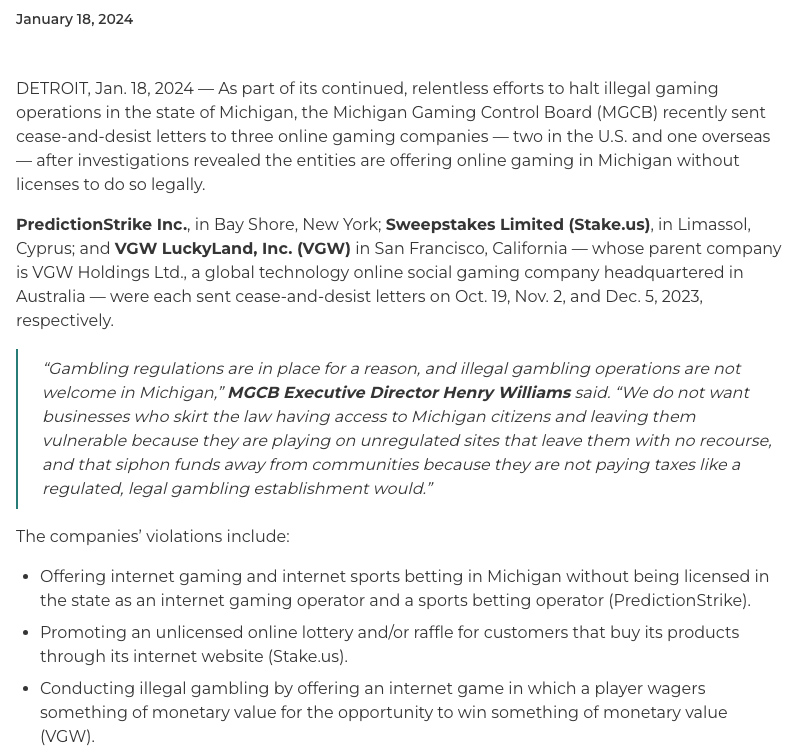
Figure 4: Michigan sent cease-and-desist letters to two sweepstakes operators in late 2023, years before most states legislated. Source: Michigan Gaming Control Board, MGCB sends cease-and-desist letters, Jan 2024. Screenshot of the source page, captured 28 Oct 2026.
Which regulators have ordered sweepstakes casinos out?
Gaming regulators in at least four states have acted under laws already on the books.
- Arizona and Louisiana took enforcement action against sweepstakes operators under pre-existing laws (American Gaming Association, May 2026).
- Michigan sent cease-and-desist letters to PredictionStrike, us and VGW LuckyLand on 19 October, 2 November and 5 December 2023 (Michigan Gaming Control Board, Jan 2024).
- Michigan alleged VGW offered a game in which players wager something of monetary value for a chance to win something of monetary value (Michigan Gaming Control Board, Jan 2024).
- Michigan alleged us promoted an unlicensed online lottery or raffle (Michigan Gaming Control Board, Jan 2024).
- Michigan issued cease-and-desist orders to 45 offshore gambling operators in the four months to April 2026 (Michigan Gaming Control Board, Apr 2026).
- Mississippi’s Gaming Commission states there are no legal exceptions for so-called sweepstakes casinos (Mississippi Gaming Commission, Jun 2025).
- The Commission is providing criminal case files to state and federal law enforcement and requesting prosecution (Mississippi Gaming Commission, Jun 2025).
- Mississippi warns that players themselves could face criminal prosecution and forfeiture of money deposited with these sites (Mississippi Gaming Commission, Jun 2025).
- Mississippi’s letters cite federal law too, including the Unlawful Internet Gambling Enforcement Act and the Wire Act (Mississippi Gaming Commission, Jun 2025).
Why are courts a risk for sweepstakes operators?
Because a federal appeals court has already ruled that virtual casino currency can be a thing of value.
- The Ninth Circuit held that Big Fish Casino’s virtual chips are a thing of value, making the game illegal gambling under Washington law (US Court of Appeals for the Ninth Circuit, Mar 2018).
- Washington law lets a player recover money or anything of value lost to an illegal gambling game (US Court of Appeals for the Ninth Circuit, Mar 2018).
- Utah’s recovery statute applies to anyone who operates or receives revenue from a gambling device, and the current version took effect on 7 May 2025 (Utah Legislature, Code 76-9-1412, May 2025).
How do sweepstakes casinos compare with legal online casinos?
Legal online casinos are growing fast in the few states that allow them, and the illegal market is growing alongside. Sweepstakes casinos sit between the two: popular where real-money iGaming is not legal, and taxed nowhere.
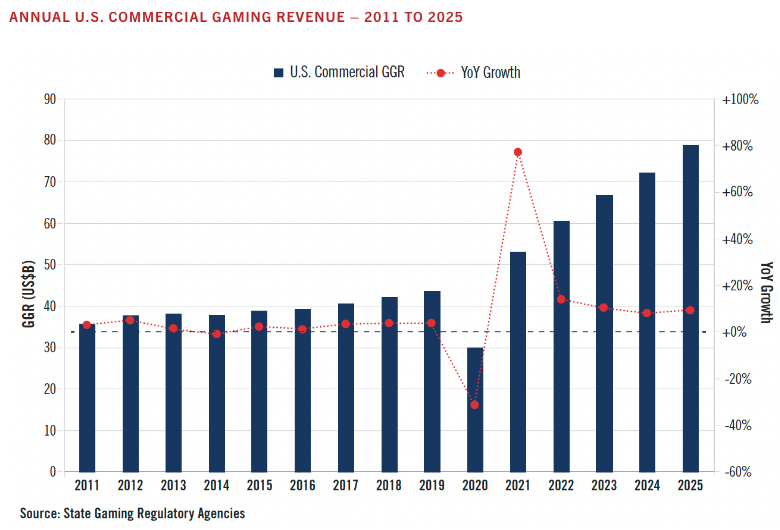
Figure 5: US commercial gaming revenue has set a record every year since 2021, compiled by the AGA from state gaming regulators. Source: American Gaming Association, State of the States 2026, May 2026; data from state gaming regulatory agencies. Chart published by the source, captured 28 Oct 2026.
How big is the legal US gaming market?
Bigger than ever.
- US commercial gaming revenue reached a record $78.62B in 2025, up 9.1% (American Gaming Association, May 2026).
- 34 of 38 commercial gaming states plus DC set annual revenue records (American Gaming Association, May 2026).
- Commercial gaming generated a record $17.86B in gaming tax revenue, up 12.3% (American Gaming Association, May 2026).
- 493 commercial casinos across 27 states earned a record $51.06B from traditional casino games (American Gaming Association, May 2026).
How big is legal online casino gaming?
Over $10B a year, concentrated in three states.
- Michigan, New Jersey and Pennsylvania account for nearly 90% of US iGaming revenue (American Gaming Association, May 2026).
- Annual iGaming revenue overtook land-based casino revenue in Pennsylvania and New Jersey for the first time in 2025 (American Gaming Association, May 2026).
- Delaware, Rhode Island and West Virginia posted the strongest iGaming growth in 2025 (American Gaming Association, May 2026).
- Maine was the only state to pass iGaming legalization in 2025, and it became law in early 2026 (American Gaming Association, May 2026).
- US iGaming revenue was $1.03B in August 2026, up 12.3% year over year (American Gaming Association, Oct 2026).
- Pennsylvania iGaming revenue reached $2.78B in 2025, up from $2.18B in 2024 (Pennsylvania Gaming Control Board, Jan 2026).
- Pennsylvania iGaming revenue has grown almost fivefold since 2020, when it was $566M (Pennsylvania Gaming Control Board, Jan 2026).
- Pennsylvania’s retail slot revenue slipped 0.62% to $2.43B, now below iGaming (Pennsylvania Gaming Control Board, Jan 2026).
- Pennsylvania’s combined gaming revenue hit a record $6.80B, up 10.74% (Pennsylvania Gaming Control Board, Jan 2026).
- Pennsylvania collected a record $2.98B in gaming taxes and fees (Pennsylvania Gaming Control Board, Jan 2026).
- New Jersey internet gaming win was $2.91B in 2025, up 22.0% (New Jersey Division of Gaming Enforcement, Jan 2026).
- New Jersey’s nine casino hotels won $2.89B, up 2.7% (New Jersey Division of Gaming Enforcement, Jan 2026).
- New Jersey internet gaming win was $273.2M in December 2025, up 19.8% (New Jersey Division of Gaming Enforcement, Jan 2026).
- Michigan iGaming gross receipts reached $3.1B in 2025 (Michigan Gaming Control Board, Jan 2026).
- Michigan’s combined iGaming and online sports betting receipts were $3.8B, up 29.5% (Michigan Gaming Control Board, Jan 2026).
- Michigan iGaming receipts hit a monthly record of $315.8M in December 2025, beating October’s $278.5M (Michigan Gaming Control Board, Jan 2026).
- Michigan’s December iGaming adjusted gross receipts were up 35.1% on December 2024 (Michigan Gaming Control Board, Jan 2026).
How big is the illegal and unregulated market?
Roughly a third of all US gambling. These figures cover every illegal operator, not sweepstakes casinos alone.
- The illegal market has grown 22% since 2022 (American Gaming Association, Aug 2025).
- Illegal operators hold 31.9% of the total US gaming market (American Gaming Association, Aug 2025).
- Illegal and unregulated operators generate an estimated $53.9B in annual revenue (American Gaming Association, Aug 2025).
- States lose an estimated $15.3B in taxes a year to illegal operators (American Gaming Association, Aug 2025).
- Illegal online slots and table games reached $18.6B in revenue, up nearly 38% since 2022 (American Gaming Association, Aug 2025).
- 49% of online casino players use both legal and illegal sites, nearly triple the 2022 share (American Gaming Association, Aug 2025).
- Illegal sportsbooks’ share of US sports betting fell from 36% to 24% (American Gaming Association, Aug 2025).
- More than 625,000 unregulated gaming machines now operate in bars, restaurants and convenience stores, up 7.7% since 2022 (American Gaming Association, Aug 2025).
- Those machines generated $30.3B in revenue and cost states $9.5B in lost tax revenue (American Gaming Association, Aug 2025).
- Americans wagered an estimated $84B with illegal bookies and offshore sportsbooks in a year, costing $1B in taxes (American Gaming Association, Aug 2025).
What are the risks for sweepstakes casino players?
Sweepstakes casinos sit outside the responsible-gaming rules licensed operators must follow, so players carry more of the risk themselves. The data below covers all US gambling, not sweepstakes play alone. If any of it sounds familiar, our responsible gaming resources list free, confidential help.
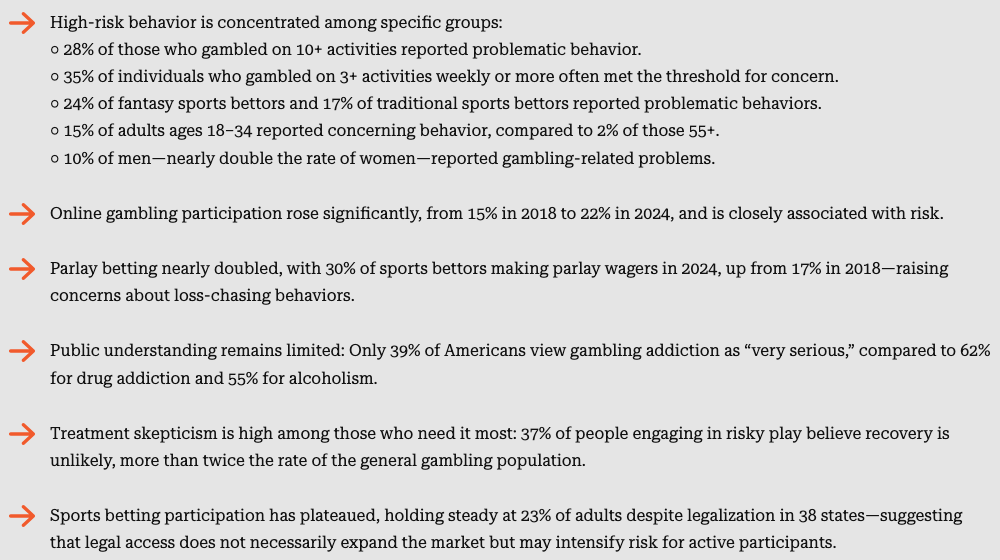
Figure 6: Risk concentrates among people who gamble often, across many activities, and online, which describes many sweepstakes players. Source: National Council on Problem Gambling, NGAGE 3.0 survey release, Jul 2025. Screenshot of the source page, captured 28 Oct 2026.
How common is problem gambling in the US?
About one adult in twelve reports a warning sign. NCPG notes this is not a measure of clinical addiction.
- 8% of US adults, almost 20 million people, reported at least one problematic gambling behavior many times in the past year (National Council on Problem Gambling, NGAGE 3.0, Jun 2025).
- That is down from 27.5 million people in 2021 (National Council on Problem Gambling, Jul 2025).
- The share reporting at least one of four risk behaviors grew from 7% in 2018 to 11% in 2021 (National Council on Problem Gambling, NGAGE 3.0, Jun 2025).
- 71% of adults gambled on at least one activity in 2024, the same as in 2018 (National Council on Problem Gambling, NGAGE 3.0, Jun 2025).
Who is most at risk?
Frequent, multi-activity and online gamblers.
- 10% of men reported gambling-related problems, nearly double the rate of women (National Council on Problem Gambling, Jul 2025).
- 28% of people who gambled on 10 or more activities reported problematic behavior (National Council on Problem Gambling, Jul 2025).
- 35% of those who gambled on three or more activities weekly met the threshold for concern (National Council on Problem Gambling, Jul 2025).
- 19% of people making at least some bets online met at least one problem-gambling criterion (National Council on Problem Gambling, NGAGE 3.0, Jun 2025).
- 24% of fantasy sports players and 17% of traditional sports bettors reported problematic behaviors (National Council on Problem Gambling, Jul 2025).
- 30% of sports bettors made parlay bets in 2024, up from 17% in 2018 (National Council on Problem Gambling, Jul 2025).
- Sports betting participation held at 23% of adults (National Council on Problem Gambling, Jul 2025).
How many people know where to get help?
About a third.
- 36% of adults have heard of the national problem gambling helpline number (National Council on Problem Gambling, NGAGE 3.0, Jun 2025).
- Awareness rises to 59% among people who bet on seven or more activities (National Council on Problem Gambling, NGAGE 3.0, Jun 2025).
- 80% believe the number exists to help people dealing with a gambling addiction (National Council on Problem Gambling, NGAGE 3.0, Jun 2025).
- Only 39% of Americans view gambling addiction as very serious, compared with 62% for drug addiction and 55% for alcoholism (National Council on Problem Gambling, Jul 2025).
- 37% of people engaging in risky play believe recovery is unlikely, more than twice the 15% among other gamblers (National Council on Problem Gambling, NGAGE 3.0, Jun 2025).
Glossary
- AMOE: Alternative Method of Entry, the free, no-purchase way to get Sweeps Coins.
- Gold Coins: play-only currency players buy, with no cash value. See Gold Coins vs Sweeps Coins.
- Sweeps Coins: promotional currency that can be redeemed for prizes.
- Dual-currency model: the Gold Coin and Sweeps Coin structure sweepstakes casinos use.
- Redemption: cashing Sweeps Coins out for cash or gift cards.
- GGR: gross gaming revenue, the amount wagered minus winnings paid.
- iGaming: licensed real-money online casino gaming.
- PPG: pari-mutuel-powered gaming, casino-style games settled on horse-race pools.
- ADW: advance-deposit wagering, the license type PPG runs on.
- Cease-and-desist: a regulator’s order to stop offering a product in a state.
- EKG: Eilers & Krejcik Gaming, the research firm behind the market estimates.
- AGA: American Gaming Association, the trade group for licensed commercial casinos.
- NGAGE: NCPG’s National Survey on Gambling Attitudes and Gambling Experiences.
Find more explanations in our sweepstakes glossary.
Methodology and Sources
Every statistic here was traced to the organization that produced it and checked on that organization’s own page or document before inclusion. We do not cite statistics roundups, affiliate sites, or news coverage of data. Market estimates come from Eilers & Krejcik Gaming, a private research firm, because no state regulates or reports sweepstakes casino revenue. Player-survey data comes largely from the American Gaming Association, which opposes sweepstakes casinos; problem-gambling data from the National Council on Problem Gambling covers all gambling, not sweepstakes play alone. Figures marked with a month are dated to the source’s publication. This page is reviewed and updated monthly.
Sources
- American Gaming Association, Sweepstakes Casino Player Profile & Advertising Trends, Jul 2025
- American Gaming Association, State of the States 2026, May 2026
- American Gaming Association, New AGA Analysis Reveals Illegal Gaming Remains Nearly a Third of the U.S. Market, Aug 2025
- American Gaming Association, Commercial Gaming Revenue Tracker, August 2026, Oct 2026
- Eilers & Krejcik Gaming, Casino Without iCasino: The Rise of Reveal Gaming, Oct 2026
- California State Legislature, AB-831 Bill Status, Oct 2025
- California State Legislature, AB-831 Bill Text, Oct 2025
- New York State Senate, S5935-A, Dec 2025
- Connecticut General Assembly, SB 1235 / Public Act 25-112, Jun 2025
- Maine Legislature, LD 2007, Apr 2026
- Louisiana Legislature, HB 883, May 2026
- Oklahoma Legislature, SB 1589, May 2026
- Utah State Legislature, Utah Code 76-9-1412, May 2025
- Michigan Gaming Control Board, MGCB sends cease-and-desist letters, Jan 2024
- Michigan Gaming Control Board, Cease-and-desist orders to 45 illegal offshore gambling operators, Apr 2026
- Michigan Gaming Control Board, December 2025 iGaming revenue, Jan 2026
- Mississippi Gaming Commission, Public Notice, June 2025, Jun 2025
- US Court of Appeals for the Ninth Circuit, Kater v. Churchill Downs, No. 16-35010, Mar 2018
- Pennsylvania Gaming Control Board, Record Gaming Revenue for 2025, Jan 2026
- New Jersey Division of Gaming Enforcement, December 2025 Gaming Revenue Results, Jan 2026
- National Council on Problem Gambling, NGAGE 3.0 Key Findings, Jun 2025
- National Council on Problem Gambling, NGAGE 3.0 survey release, Jul 2025
- Kim, Wohl, Salmon, Gupta and Derevensky, Do Social Casino Gamers Migrate to Online Gambling?, Journal of Gambling Studies, Nov 2014