If you’ve never used a sweepstakes casino before, our complete beginner’s guide to sweepstakes casinos is a good start.
This guide covers how the two-currency system works, why these sites are allowed to operate in states where online casinos aren’t, and what actually happens from the moment you sign up to the moment money lands in your account. By the end of this article, you should have a good understanding of how sweepstakes casinos work and if they are a good choice for you.
What is a sweepstakes casino?
A sweepstakes casino is a website that works similarly to an online casino, but instead of real money, you bet virtual coins.
You can play a range of standard casino games, such as slots, blackjack, roulette, and live-dealer games. They look and behave exactly like the games in a real online casino, and in most cases, they are the exact same games.
The big difference compared to a regular online casino is that you’re never placing real-money bets. You’re playing with virtual coins, Gold Coins (GC) and Sweeps Coins (SC), where the GC are largely worthless, while SC can be swapped for actual cash prizes when you’ve got enough of them.
Another key feature is that you don’t deposit into a sweepstakes casino; you purchase packages. These packages consist of various amounts of Gold Coins and Sweeps Coins, with the latter being what really makes it worth the money.
Why play in sweepstakes casinos over regular casinos?
The reason any of this exists comes down to availability. Regulated online casinos are legal in only seven US states, whereas sweepstakes platforms operate in about thirty-six, so for millions of people in Texas, Florida, or Georgia, this is simply the only way to play casino games at home. You can look at our legal sweepstakes states guide for an up-to-date look at the situation.
You’ll see them called social casinos, sweeps casinos, or gold coin casinos depending on who’s writing, but they’re all describing the same thing.
Why sweepstakes aren’t legally gambling
In most US states, something only counts as gambling if three things are true at once: there’s a prize, the outcome is decided by chance, and you had to pay to take part. That third element is the one sweepstakes casinos remove.
Because there’s always a way to get the prize currency (Sweeps Coins) without paying, taking part never requires money to change hands. You can obtain Sweeps Coins without spending a penny, and we’ll cover the free options further in this article. However, purchasing packages is by far a much faster option.
Since you’re buying Gold Coins, and the Sweeps Coins are complimentary to the package, legally speaking, you’re not using real money. You’re also not wagering real money. That’s the whole argument, and it’s less exotic than it sounds.
The Sweepstakes structure isn’t new in itself or unique to casinos. You’ve encountered the same structure before without thinking about it. McDonald’s Monopoly works this way, as did the prize codes under soft-drink caps and every magazine sweepstakes that ever printed “no purchase necessary” on the entry form.
Around 2016, someone applied the framework to casino games and put it online, which made the product look completely different even though the underlying legal structure hadn’t changed at all.
The two currencies
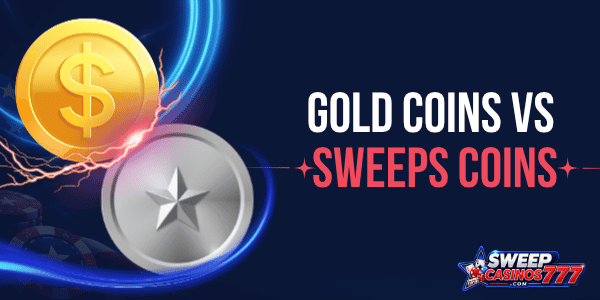 In a sweepstakes casino, you have Gold Coins and Sweeps Coins, and the difference is crucial to understand. Gold Coins are essentially worth nothing, while the Sweeps Coins are what you really want.
The difference between the currencies is always confusing to new players, but critical to get right. Our guide explaining the difference between Gold Coins and Sweeps Coins can give you a better understanding, but you can also learn the basics below:
Gold Coins
Gold Coins are entertainment and nothing else. You get a large pile free when you sign up; you can buy more if you feel like it, and you can win more by playing the games. They can seem unlimited at times. However, there’s no circumstance in which you can turn them into money. It’s free-play money and nothing else.
The comparison that helps most people is arcade tokens: a good run on the machines genuinely feels like winning, and the tokens still never leave the arcade.
Some Sweeps Casinos use different names for Gold Coins, and you’ll commonly see names like Fun Coins or Blitz Coins used, to name a few. The function is still identical wherever you go.
Sweeps Coins
Sweeps Coins are the ones that can actually become real money, redeemable at roughly a dollar a coin at most sweepstakes casinos. Still, it’s worth checking your specific site because a few differ.
You’ll never buy them directly, which sounds like a restriction until you realize it’s the entire reason the model is allowed to exist. They have to be obtainable for free, so they reach you through daily login bonuses, codes dropped on social media, referral rewards, the postal request route, and bundled in alongside any Gold Coins you happen to purchase.
Pay attention to the minimum redemption limit for Sweeps Coins. Some require a minimum of 50 SC before you can redeem them, while others require 100, and it will take much longer to turn them into real money.
Telling them apart
The numbers give it away immediately once you know to look. Gold Coins arrive in the hundreds of thousands, even millions, while Sweeps Coins arrive in ones and tens. An offer shouting about “1,000,000 Gold Coins + 30 Sweeps Coins” is, in any meaningful sense, a thirty Sweeps Coin offer with a lot of decoration attached.
The biggest beginner mistake is one of two things: Either they get excited about an enormous Gold Coin balance that was never going to be worth anything, or they burn through their small Sweeps Coin balance thinking they’re using the Gold Coins.
Both are avoidable as long as you know the difference between the currencies and pay attention to which one you’re using right now.
The two modes: Standard and Sweepstakes
Every platform runs two modes with a toggle between them, usually somewhere obvious. However, it’s easy to miss it if you’re brand-new to sweepstakes.
- Standard mode plays with Gold Coins, and nothing you win there can ever be redeemed. This mode is genuinely useful for learning a game you haven’t played before, or testing different betting strategies.
- Sweepstakes mode plays with Sweeps Coins and is where any actual prize comes from. It’s most comparable to playing in a real online casino.
The casino games themselves don’t change between modes. You’ll find the same slots, same odds, same everything. Only the currency at stake is different, which is exactly why it’s easy to forget which one you’re in.
How to sign up to a sweepstakes casino
To start playing at a new sweepstakes casino, you first need to register. This takes a few minutes, and you’ll need to provide your email address, username, password, date of birth, and confirmation of where you live, since not every operator serves every state.
We advise you to be truthful and not use a VPN, as this can cause you trouble later on, but we’ll get back to that.
Most sweepstakes sites hand you a small sign-up bonus once you have confirmed your account details. You will normally receive a larger dose of SC compared to other free means, so it’s worth taking advantage of. However, check the conditions to ensure you have time to fully use the offer. If not, you may want to sign up later.
Later, if you wish to purchase a package, you can normally take advantage of a welcome bonus/package, with something considerably larger attached to your first Gold Coin purchase. However, spending money is never required.
How old do you need to be to play sweepstakes?
Most sweepstakes casinos have a legal age limit of 18+, but a fair few set their own minimum at 21+ regardless. No sweepstakes casinos we’ve encountered so far have a higher legal age limit.
Do your verification now, not later
Our best advice is to get your identity verified on the day you register rather than on the day you want your money.
Before you can make your first redemption, you always need to go through a KYC (know your customer) process to ensure you are who you claim to be and your details are correct. If you do it early, before you spend effort and perhaps money to collect Sweeps Coins, you know nothing will hold you back once you’re ready to redeem.
You’ll need a government photo ID and proof of address, usually a utility bill or bank statement from within the last three months. Done at signup, it’s quietly finished long before you’ve built a balance worth withdrawing, whereas left until cash-out, it adds days to your first payout. If a document gets bounced for a glare on the photo or a cropped corner, you’re resubmitting and waiting all over again.
One thing that catches people more often than it should: the name on your account, the name on your ID, and the name on your payment method all need to match. If you registered as Mike and your passport says Michael, sort that out before it becomes a problem. If you’ve recently changed your address, and especially if it’s another state, you might face even more problems.
Playing without spending anything
 You genuinely never have to buy coins. It’s always optional, and there are four routes to free Sweeps Coins that every legitimate casino offers in some combination:
- Sign-up bonuses can only be claimed once, but usually offer one of the best ratios of SC. You can compare sign-up bonuses here.
- Daily login bonuses, where opening the app/website each day earns you a small amount, often on a streak ladder that grows the longer you keep it going. Individually, these look trivial, but they’re what makes free play work over time. Our guide on how to maximize daily login bonuses can give you a good introduction to strategies.
- Social media drops, meaning codes posted on X, Telegram, Discord, or in the operator’s own live chat. These are usually worth more per event than a daily bonus, though they’re time-limited and go to whoever gets there first.
- Referrals and promotions, which pay you for bringing in a friend or completing whatever challenge is running.
- Mail-in requests, the postal route that operators are obliged to provide. Slower and more effort than the rest, but guaranteed to be there.
It can be worth looking at our sweepstakes casino bonus list to get a better picture of what’s available.
How the postal route works
The specifics vary between operators, so you should always read the actual terms, but the shape of it is consistent. You find the instructions buried somewhere in the terms under a heading like “Alternative Method of Entry”, or shortened to AMOE. You need to write the request out by hand on a postcard or plain paper because most operators insist on handwriting; include your name, address, email, and whatever exact wording they’ve specified. Then mail it to the address they give, not a general contact address.
The coins get credited to whichever account matches the email you supplied, usually within a couple of weeks. Most operators cap how often you can do this, often at one request per day or per week, and each one yields a small fixed amount. Our AMOE-guide can give you more info on the topic.
While it often gives you the best amount of SC compared to many other free options, few people actually do it because it’s a hassle.
Can free-play reward real money?
It can, but the process is slow, and it’s worth being honest about what that means. It requires lots of grinding.
Each casino has different terms and limits that can make it challenging to really understand how soon you’re realistically looking at a redemption option. Before deciding on a Sweepstakes casino, look at the free options that exist and make a rough table to see how many days it will take before you can cash out. You should pay special attention to:
- The minimum redemption limit: This dictates how many SC you need before you can cash out. If the limit is high (100+) you likely need to wait a long time.
- Daily login bonuses: Look at how many days you need to log in before you meet the redemption minimum. Some offer streak bonuses, which can make it more effective.
- Other free options: Consider the other methods to obtain SC, like sign-up bonuses, referrals, mail-in requests, and other promotions.
Stack the free routes together, and you can build a redeemable balance without ever paying anything. Plenty of people have cashed out without spending anything at all. What you can’t do is build it quickly, so if you’re picturing a large payout on a budget of nothing, you’ll be waiting a very long time. Realistically, you’re looking at 1-2 months with frequent participation before you can redeem anything.
The fair way to think about it is that free play lets you enjoy the games and occasionally win a modest prize, which is reasonable and not a shortcut to money.
Buying coins, if you want to
Packages usually start somewhere around two dollars and run up past a hundred. What you’re actually purchasing is Gold Coins, and the Sweeps Coins that come attached are a free bonus riding along with the sale.
Two things worth being clear about. Buying is optional at every Sweeps Casino, and buying doesn’t improve your chances of winning. Sweeps Coin that arrived by post behaves exactly like one that came with a ninety-nine dollar package.
What money buys you is speed, in the sense that you reach a redeemable balance faster, and that’s genuinely all it buys.
Playthrough, or why your balance sometimes won’t move
Sweeps Coins can’t be redeemed the second you receive them, because most operators apply a playthrough requirement. This means that you need to use each sweep coin at least once, but in some cases more.
The common playthrough requirement is 1x, but we advise you to always check the casino’s terms since some have a higher requirement.
By the standards of real-money casino bonuses, this is a very light restriction. Still, it catches people out regularly. If you’re staring at a balance you can’t withdraw, unplayed coins are almost always why, and most platforms will show you your total and redeemable balances as separate figures if you look.
The habit that avoids the whole issue is playing coins through as they arrive, so that whenever you decide to cash out, the balance is already ready to go. Chances are that some will be lost along the way, so you may no longer meet the minimum redemption amount once fully wagered.
Getting your first payout
Once your Sweeps Coins have cleared playthrough and you’re above the casino’s minimum redemption limit, you can put in a redemption request.
The minimum redemption limit
Usually somewhere between fifty and a hundred Sweeps Coins. This matters enormously if you’re playing free, because a fifty-coin minimum takes roughly half as long to reach as a hundred-coin one. That difference compounds when you’re collecting fractions of a coin a day.
Redemption methods
Most sweepstakes casinos will have a range of options available to redeem your SC:
- Cryptocurrency is the quickest payment method, often landing within hours once approved, though it does assume you’re comfortable holding a wallet. Learn more about using cryptos at sweepstakes in our guide.
- Gift cards usually turn up by email within a day or two.
- E-wallets like Skrill are fast where they’re offered, typically same or next day.
- ACH bank transfer is the most widely available and the slowest of the lot, running two to five business days and moving only on banking days.
Your first redemption will often be slower than every one after it, because verification runs alongside it. Unless you took the advice earlier and got that out of the way at signup, in which case it won’t.
When to ask
Requests get reviewed during business hours, and banks only move money on banking days, so a Monday morning request puts you at the front of the week while a Friday evening one might not go anywhere until Tuesday. Public holidays stretch it further. The timeline can vary between sweepstakes casinos since some are more efficient than others. Our fast sweepstakes payout guide can give you a bit more info.
Do I need to pay taxes on sweepstakes redemptions?
Redemptions count as taxable income under federal law in all fifty states, whether or not your state charges income tax of its own. Operators generally issue a Form W-2G once prizes hit six hundred dollars, but that threshold isn’t a line below which winnings stop being income. Smaller amounts are still taxable; they’re just not automatically reported.
Keep your own record of what you’ve redeemed, and talk to somebody qualified rather than relying on whatever the operator’s help pages say.
Choosing the right sweepstakes casino
Once you’re past the basics, the biggest question comes down to where to play. A good start can be to pick from our list of best sweepstakes casinos 2026, as they have been quality-tested and are better for beginners. Still, you should know how to pick the right ones yourself.
Four questions separate a good sweepstakes casino from one that’ll frustrate you:
- Does it pay reliably? Far and away the most important, because a generous bonus is worth nothing if getting money out turns into a fight.
- What’s the redemption minimum? Critical if you’re playing free, less so if you’re buying coins regularly.
- Is the free entry route easy to find? How an operator treats an obligation it can’t avoid tells you plenty about how it treats the ones it can.
- Are the player-protection tools real? Deposit limits, cooling-off periods, self-exclusion — set before you need them rather than after.
Bonus size comes in some way below all four, which is roughly the opposite of how most sites present it. Although bonuses can be important, they are worth nothing if the platform is rogue.
Mistakes worth avoiding
- Losing track of which currency you’re playing, and spending the one that mattered.
- Leaving verification until cash-out, then assuming the operator is stalling.
- Chasing the biggest headline number, which is nearly always the Gold Coin figure.
- Signing up at eight platforms and never verifying any of them properly.
- Letting a large balance sit rather than redeeming as you go.
- Missing expiry dates, both on offers and on unused promotional coins.
Frequently Asked Questions
Where to go next
If anything above felt unclear, feel free to ask our AI assistant or read one of our other sweepstakes guides for more information.
Sometimes, the best way to learn is simply by doing. Start by signing up at a casino for free and try playing with Gold Coins only in the beginning.





Terms used in this article
- Gold Coins
- Virtual currency in sweepstakes casinos that has no monetary value and cannot be converted to real money; used for entertainment and free-play purposes only.
- Sweeps Coins
- Virtual currency in sweepstakes casinos that can be redeemed for actual cash prizes at a rate of approximately one dollar per coin.
- Two-currency system
- The structure in sweepstakes casinos that separates worthless Gold Coins from redeemable Sweeps Coins to maintain legal compliance with gambling regulations.
- Standard mode
- A play mode in sweepstakes casinos using Gold Coins where winnings cannot be redeemed for money, useful for learning games and testing strategies.
- Sweepstakes mode
- A play mode in sweepstakes casinos using Sweeps Coins where wins can be converted into actual cash prizes, comparable to playing in a real online casino.
- KYC
- Know Your Customer process; a verification requirement in sweepstakes casinos that confirms player identity and account details before allowing redemptions.
- Alternative Method of Entry
- A postal route system that allows players to obtain free Sweeps Coins by mail as a legally required alternative to purchasing packages, typically by sending a handwritten request.
- Sign-up bonus
- A one-time promotional offer of Sweeps Coins and Gold Coins given to new players upon account registration and verification.
- Daily login bonus
- A recurring reward of Sweeps Coins earned by opening the sweepstakes casino app or website each day, often increasing with consecutive days of activity.