Where you are decides what you can play. Most states still have operators serving players, but the map has moved a lot since 2025, and “available” doesn’t always mean the same thing as “settled.”
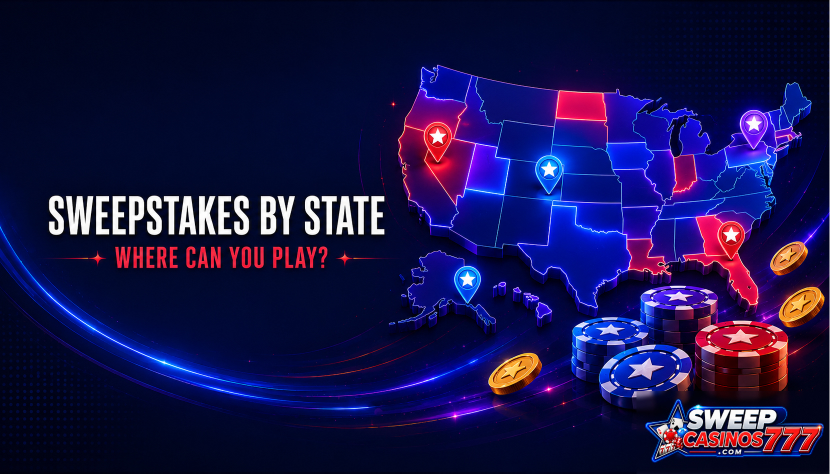
Map of legal states for sweepstakes casinos
Please note that we have no idea where you’re sitting right now, and we can’t check it for you. Laws change fast in this space, operators update their own restricted lists constantly, and what’s on this page could be out of date by the time you read it. As a result, we always advise you to check the current laws in your state.
So treat this as a starting point, not an answer. Before signing up anywhere, check the operator’s own list of states it serves since that’s the most current source there is. Operators update it the moment anything shifts. That’s why some of the casinos on our best sweepstakes casinos list won’t be available to you after clicking our button.
If you want certainty about your own situation, that’s a question for a lawyer rather than a website. Nothing here is legal advice, and working out whether you can play where you live is on you.
Hover a state to see its status.
What the labels mean
Open — no ban we’re aware of, operators serve the state normally, plenty of choice.
Limited — you can probably play, but with fewer operators. Something is going on: legislation moving, regulators making noise, or operators quietly deciding it’s not worth the hassle.
Closed — reputable operators won’t take you. Sometimes that’s a law, sometimes an attorney general, sometimes gambling rules that were already on the books.
The second set of laws nobody mentions
Most guides only talk about whether sweepstakes count as gambling. There’s a whole other layer, and it catches people out.
Separate from gambling law, several states have their own rules for prize promotions generally — registration, bonding, what you can and can’t say in the official rules. Florida and New York both require an operator to register and post a bond once total prize value passes $5,000. Rhode Island wants registration above $500, though only for promotions run in physical shops, so online play doesn’t trigger it.
You’ve probably already bumped into this without knowing. Ever noticed Florida players capped at $4,999 per win? That’s not a coincidence. Operators sit just under Florida’s $5,000 threshold to avoid the bonding requirement.
Georgia has the strictest version, and it’s why we’ve marked it Limited despite there being no ban. Georgia’s promotional statute works as a checklist: disclosed odds, verifiable prize values, and a flat prohibition on substituting prizes. A promotion has to conform to all of it to sit outside the state’s lottery definition. Since most operators’ terms reserve the right to swap prizes for something of equal value, there’s a genuine tension there. Several operators have exited Georgia and later returned, which suggests they’re not certain either.
The pattern behind all of this
The map isn’t random, and once you spot the pattern, you can predict most of it.
The South and Mountain West are overwhelmingly open, mostly because those states have little commercial gambling to protect. The Northeast is the most closed region in the country, and it’s also where regulated online casinos are most established. The Midwest is split. The West is fragmented — California, Washington, Nevada, Idaho and Montana closed, Colorado, New Mexico, Oregon and Wyoming open.
If you want one predictor of whether a state moves against sweepstakes, it isn’t politics. It’s whether the state already collects tax revenue from a regulated online casino. Every one of the seven online casino states has either banned sweepstakes or watched operators leave voluntarily.
Every state, A to Z
Alabama — Limited
5.19 million people. No ban, but Alabama’s gambling rules are among the tightest anywhere, and plenty of operators skip it rather than find out. Expect a short list.
Alaska — Open
737,000 people. No ban, nothing pending. Too small to be anyone’s priority market, but access is fine.
Arizona — Limited
7.62 million. Still available, but operators have been drifting away after regulatory pressure. Big tribal gaming sector, which tends to correlate with pressure on sweepstakes.
Arkansas — Open
3.11 million. A 2025 ban bill failed. Decent coverage.
California — Closed
39.36 million, the biggest state in the country. AB 831 took effect on 1 January 2026, and it’s unusually wide — liability reaches payment processors and affiliates, not just operators. Stake.us, Pulsz, McLuck and Chumba all left before the deadline.
Colorado — Open
6.01 million. No ban, good range of operators, despite legal sports betting.
Connecticut — Closed
3.69 million. Banned outright under Public Act 25-112. Connecticut also runs its own online casino, which is a pattern you’ll notice repeating.
Delaware — Limited
1.06 million. No ban, but Delaware has its own online casino, and most operators exclude it. Options are thin.
District of Columbia — Limited
694,000. No specific prohibition, small market, limited operator interest.
Florida — Limited
23.46 million, third-largest state and one of the biggest sweepstakes markets going. Four ban bills were filed in 2026, and all died when the session ended in March, but the Seminole Tribe is expected to back another run in 2027. Also, you’ll hit that $4,999 cap. Play, but don’t hoard a balance. Learn more about sweepstakes casinos Florida in our guide.
Georgia — Limited
11.30 million. No ban, and most operators serve it, so you can probably play. But Georgia’s promotional statute is a strict conformity checklist rather than a general no-consideration test, and prize substitution is flatly prohibited. Operators have left and returned. Worth knowing before you build a balance.
Hawaii — Limited
1.43 million. Odd one. Hawaii bans all gambling essentially, yet sweepstakes remain technically available under promotional rules. A 2026 ban bill was deferred. Coverage is patchy.
Idaho — Closed
2.03 million. No explicit ban, but state law stops players from receiving cash prizes, which removes the point entirely.
Illinois — Limited
12.72 million, sixth-largest. Under the heaviest enforcement pressure of any state that’s still open — the attorney general sent cease-and-desist letters to more than 60 operators in early 2026 and several have gone. Still a large population, but coverage is shrinking.
Indiana — Closed
6.97 million. HB 1052 passed in 2026. Notably, the debate included talk of licensing rather than pure prohibition, which other states may copy.
Iowa — Limited, and tightening
3.24 million. SF 2289 was signed on 15 May 2026, giving Iowa’s gambling regulator power to shut sweepstakes operators down from 1 July 2026. Most major brands still serve Iowa for now. That could change quickly.
Kansas — Open
2.98 million. No ban, normal coverage.
Kentucky — Limited
4.61 million. No state ban and no regulator action, but private lawsuits under Kentucky’s gambling-loss recovery law have pushed more than 30 brands out. Practically, choice is very limited.
Louisiana — Closed
4.62 million. HB 53 was signed in May 2026, making Louisiana the only state where operating a sweepstakes casino counts as racketeering. It reaches operators, processors and affiliates.
Maine — Closed
1.41 million. LD 2007 took effect 14 July 2026.
Maryland — Limited
6.27 million. No ban — two 2026 bills failed in the Senate — but operators left after cease-and-desist letters from the state lottery and gaming agency. Another attempt looks likely in 2027.
Massachusetts — Limited
7.15 million. Available now. A ban bill was sent to study and expired, but it can come back, and the gaming commission is watching.
Michigan — Closed
10.13 million. Closed since 2024 under existing gambling law, enforced directly by the Gaming Control Board. Michigan runs one of the most successful online casino markets in the country, which is rather the point.
Minnesota — Limited
5.83 million. Ban legislation advanced through Senate committees in 2026 and is still live. Operators are serving the state for now.
Mississippi — Limited
2.95 million. SB 2104 passed the Senate unanimously before moving to the House. A ban looks more likely than not.
Missouri — Open
6.27 million. Good coverage, though Stake.us has faced litigation here, so individual operator availability varies.
Montana — Closed
1.14 million. SB 555 was the first explicit ban in the country, effective 1 October 2025. The one that started the wave.
Nebraska — Open
2.02 million. No ban, conservative gambling climate, moderate coverage.
Nevada — Closed
3.28 million. Shut without needing new legislation — the Gaming Control Board treats these platforms as unlicensed gambling. Not a surprise in Nevada.
New Hampshire — Open
1.42 million. No ban, normal availability.
New Jersey — Closed
9.55 million. Banned by statute in August 2025, alongside one of the largest regulated online casino markets in the US. The commercial motivation was never really disguised.
New Mexico — Open
2.13 million. No ban, reasonable coverage.
New York — Closed
20.00 million, fourth-largest. Banned by statute, operators gone. New York and California, between them, took nearly 60 million people out of the market.
North Carolina — Open
11.20 million and one of the fastest-growing states, up 7.2% since 2020. No ban we’re aware of and broad operator coverage.
North Dakota — Open
799,000. No ban, normal access.
Ohio — Open
11.90 million, seventh-largest. Legal sports betting, no online casino, no sweepstakes ban. Bills have been floated without success. One of the larger open markets.
Oklahoma — Closing 1 November 2026
4.12 million. SB 1589 passed after a veto override and takes effect on 1 November 2026. Until then, you can still play. If you’re in Oklahoma with a balance, redeem it well before that date — access usually cuts on the deadline rather than winding down gently.
Oregon — Open
4.27 million. No ban, though some operators skip Oregon out of caution.
Pennsylvania — Limited
13.06 million, fifth-largest. No ban, but Pennsylvania has a big regulated online casino market and plenty of operators list it as restricted. Varies a lot by brand.
Rhode Island — Limited
1.11 million. No ban, but its own online casino market means most operators exclude it. Rhode Island’s promotional registration rules only apply to in-store promotions, so they don’t affect online play.
South Carolina — Open
5.57 million, and the fastest-growing state by percentage in 2025. No ban, good coverage.
South Dakota — Limited
935,000. Available, but South Dakota has its own dedicated sweepstakes statute and has published advisories that online casino-style play isn’t authorized. Some operators stay away.
Tennessee — Closed
7.32 million. Started as attorney-general enforcement, now backed by a dedicated statute signed in May 2026. Operators have gone.
Texas — Open
31.71 million and a $2.9 trillion economy — second-largest state on both counts, and eighth in the world by GDP if it were a country. No commercial casinos, no legal online betting, no sweepstakes ban, and no registration or bonding regime either. Texas’s main sweepstakes statute only covers promotions run through the mail, so it doesn’t reach online play. The largest open market in the country and the one with the fewest complications attached. Our guide on Texas sweepstakes casinos can give you more information.
Utah — Open, technically
3.54 million. The genuine oddity. Utah bans all gambling, yet sweepstakes remain technically available under promotional rules. Many operators exclude it anyway, so real availability is patchy.
Vermont — Open
645,000. No ban, normal access.
Virginia — Limited
8.88 million. Available now, but two 2026 bills that would have legalized online casino and banned sweepstakes passed their chambers separately before failing to reconcile. Back in 2027, and the online casino angle makes a ban more likely.
Washington — Closed
8.00 million. Closed under long-standing law treating online casino-style play as a felony. That law predates the sweepstakes debate entirely and needed no amending.
West Virginia — Limited
1.77 million. No ban, but its online casino market means several operators exclude it.
Wisconsin — Open
5.97 million. No ban, solid coverage.
Wyoming — Open
589,000, smallest state in the country. No ban, normal access, minimal operator attention.
Where the players actually are
The fourteen closed states account for roughly 121.6 million people, leaving about 220 million where sweepstakes are still available in some form.
A caveat on that number, though. Population isn’t the same as market size. When California was banned, industry analysts put it at around 17.3% of all US sweepstakes sales despite being about 11.5% of the population, so it was pulling roughly half again what its size predicted. States with no legal alternatives tend to over-index like that, and states with regulated online casinos almost certainly under-index.
Nobody publishes per-state sweepstakes revenue, so any ranking beyond the obvious is guesswork. What can be said with confidence is that Texas is the largest open market by population and has the fewest legal complications attached, and Florida is second by population, though its $4,999 redemption cap dents what players can redeem.
Below those two, population is a poor guide. Pennsylvania and Illinois both have large populations but restricted markets; Pennsylvania because many operators exclude it, Illinois because dozens have received cease-and-desist letters and several have left. A big state with thin operator coverage isn’t a big market.
Tax, wherever you are
Redemptions count as taxable income under federal law in all fifty states, whether or not your state charges income tax. Nine don’t, including Texas and Florida.
Operators usually issue a Form W-2G at $600 or more, though some use a $2,000 threshold. Below either figure, it’s still income, just not automatically reported. Keep your own records and talk to someone qualified.
Closed casinos in the last 12 months
As a result of constant regulatory changes paired with high competition, many brands shut down entirely or close their operations in some states. It’s worth emphasizing that this isn’t a downward spiral of the industry, but rather a natural course of action.
| Sweepstakes Casino | Closure Date | What Happened | Notes |
|---|---|---|---|
| Vivaro.us | October 1, 2025 | Full shutdown | Entire US sweepstakes operation closed |
| iCasino.com | October 9, 2025 | Full shutdown | Brand ceased operations |
| Starlight Casino | November 16, 2025 | Full shutdown | Part of Sweepium-group shutdown |
| LuckyStars Casino | November 16, 2025 | Full shutdown | Part of Sweepium-group shutdown |
| OnPoint Casino | November 16, 2025 | Full shutdown | Original operation closed; later relaunched/reworked |
| TurboStakes | November 16, 2025 | Full shutdown | Part of Sweepium-group shutdown |
| Vegas Coins | November 28, 2025 | Full shutdown | Closed US operations |
| Bitsler.io | December 1, 2025 | Full shutdown | US sweepstakes operation closed |
| Betty Sweeps | January 23, 2026 | Full shutdown | Sweepstakes casino ceased operations |
| ToraTora Casino | January 23, 2026 | Full shutdown | Closed after previously exiting Illinois |
| LuckyBird.io | January 2026 | Went offline | Went offline following a maintenance notice |
| Grand Vault Casino | February 2026 | Went offline | Casino became unavailable |
| Kickr | March 31, 2026 | Full shutdown | Sweepstakes operation closed |
| Vegas Gems | March 2026 | Reported closed | Closure reported by industry trackers |
| Gold Rush City | April 5, 2026 | Full shutdown | Sweepstakes operation closed |
| Mega Frenzy | April 30, 2026 | Full shutdown | Sweepstakes operation closed |
| Cazino | April 2026 | Reported closed | Closure evidence less clear |
| NioPlay | April 2026 | Reported closed | Reportedly shut down without notice |
| Milky Star Slots | Early May 2026 | Went offline | Site became unavailable |
| Americana | May 2026 | Reported closed | Closure reported by industry trackers |
| Gold Treasure | May/June 2026 | Full shutdown | Closure announced before site closed |
| VegasGlory | May 2026 | Reported closed | Site reportedly disappeared/offline |
| WinPanda | May 2026 | Reported closed | Site reportedly went offline |
| SweepNext | May 30, 2026 | Full shutdown | Closed and users migrated to LuckyStake |
| ZanZo | June 2026 | Reported closed | Reportedly shut down without notice |
| Kirgo.us | June 2026 | Full shutdown | Sweepstakes operation closed |
| Gold Ahoy | June 2026 | Closure announced | Operator announced shutdown |
| The Money Factory | August 9, 2026 | Full shutdown | Sweepstakes operation permanently closed |
| Monster Treasure | August 2026 | Full shutdown | Sweepstakes operation closed |
| LuckyStake | August 2026 | Full shutdown | Closed following a redemption window |
| HappyEnding | August 2026 | Reported closed | Site became inaccessible; permanent closure less certain |
| The Win Zone | September 2026 | Full shutdown | PlayStudios shut down the platform |
| LuckyLand Slots | September 2026 | Full shutdown | VGW permanently closed the brand |
| CoinFrenzy | September 2026 | Full shutdown | Closed after a wind-down period |
We update this table regularly as we receive information about closures.
It’s worth noting that there are more new sweepstakes casinos launching than closing. Although the number of exits is substantial, it doesn’t mean that sweepstakes are dying; just that the competition is high.
State exits in the last 6 months
State exits are more common than full closures. Below you can see the most notable state exits that have happened in the last 6 months.
| Sweepstakes Casino | State(s) Exited | Approx. Date | Type of Exit | Main Reason |
|---|---|---|---|---|
| Chumba Casino | Indiana, Maine | July 2026 | Sweeps Coin/state restriction | New state legislation prohibiting sweepstakes casino play |
| Global Poker | Indiana, Maine | July 2026 | Sweeps Coin/state restriction | New state legislation prohibiting sweepstakes casino play |
| LuckyLand Slots | Indiana, Maine | July 2026 | Sweeps Coin/state restriction | New state legislation prohibiting sweepstakes casino play |
| LuckyLand Casino | Indiana, Maine | July 2026 | Sweeps Coin/state restriction | New state legislation prohibiting sweepstakes casino play |
| Stake.us | Indiana, Illinois | July / September 2026 | State exit/restriction | Indiana ban; Illinois regulatory enforcement |
| McLuck | Indiana, Maine | July 2026 | State exit | New state sweepstakes legislation |
| Hello Millions | Indiana, Maine | July 2026 | State exit | New state sweepstakes legislation |
| Jackpota | Indiana, Maine | June–July 2026 | State exit | New state sweepstakes legislation |
| Mega Bonanza | Indiana, Maine | June–July 2026 | State exit | New state sweepstakes legislation |
| PlayFame | Indiana, Maine | July 2026 | State exit | New state sweepstakes legislation |
| SpinBlitz | Indiana, Maine | July 2026 | State exit | New state sweepstakes legislation |
| WOW Vegas | Illinois, Indiana, Maine | May–July 2026 | Sweeps Coin/state restriction | Illinois enforcement and new Indiana/Maine restrictions |
| Rolla | Indiana, Maine | July 2026 | State restriction | New state sweepstakes legislation |
| MetaWin | Indiana, Maine | July 2026 | State restriction | New state sweepstakes legislation |
| Pulsz Casino | Indiana | May–July 2026 | Sweeps Coin restriction | Indiana sweepstakes casino ban |
| Pulsz Bingo | Indiana | May–July 2026 | Sweeps Coin restriction | Indiana sweepstakes casino ban |
| Modo.us | Indiana, Maine | May 2026 | Sweeps Coin removed; Gold Coins remained | Upcoming Indiana and Maine restrictions |
| High 5 Casino | Indiana | June–July 2026 | State exit | Indiana sweepstakes casino ban |
| ACE Casino | Indiana, Maine | May 27, 2026 | Full state exit | Upcoming Indiana and Maine restrictions |
| Zula Casino | Illinois, Indiana | June–July 2026 | Sweeps Coin/state restriction | Illinois enforcement and Indiana legislation |
| Fortune Wins | Illinois, Indiana | June–July 2026 | Sweeps Coin/state restriction | Illinois enforcement and Indiana legislation |
| Sportzino | Illinois, Indiana | June–July 2026 | Sweeps Coin/state restriction | Illinois enforcement and Indiana legislation |
| Yay Casino | Illinois, Indiana | June–July 2026 | Sweeps Coin/state restriction | Illinois enforcement and Indiana legislation |
| American Luck | Illinois, Indiana | June–July 2026 | Sweeps Coin/state restriction | Illinois enforcement and Indiana legislation |
| Luck Party | Illinois, Indiana | June–July 2026 | Sweeps Coin/state restriction | Illinois enforcement and Indiana legislation |
| Win Bonanza | Illinois, Indiana | June–July 2026 | Sweeps Coin/state restriction | Illinois enforcement and Indiana legislation |
| Funzpoints | Indiana, Tennessee | May–July 2026 | State exit | New state restrictions/legislation |
| Ruby Sweeps | Indiana | May 2026 | State exit | Upcoming Indiana sweepstakes casino ban |
| Onyx Odds | Illinois | May 2026 | Full state exit | Illinois regulatory enforcement |
What happens if your state closes?
You normally get a warning. Operators tend to announce an exit 30 to 90 days ahead and let you redeem during that window. After the deadline, accounts go inactive, and that’s that. Any Sweep Coins remaining will be lost forever.
Which leads to the one piece of practical advice worth taking from this whole page: don’t sit on a big balance. Redeem as you go, especially anywhere marked Limited.
Losing access is irritating. Losing access with money still in the account is worse, and there’s usually nobody to appeal to.
Frequently Asked Questions
How we put this together
Population figures come from US Census Bureau Vintage 2025 estimates. Where we’ve read the underlying statute ourselves — Georgia, Texas, Florida, New York and Rhode Island — we’ve said what it actually says. For the rest, we’re relying on published legislative tracking, which is generally reliable on bans and less reliable on the grey areas.
That’s worth knowing because the two aren’t the same standard, and Georgia is the reason we mention it: every tracker had Georgia down as straightforwardly fine until you read the promotional statute.